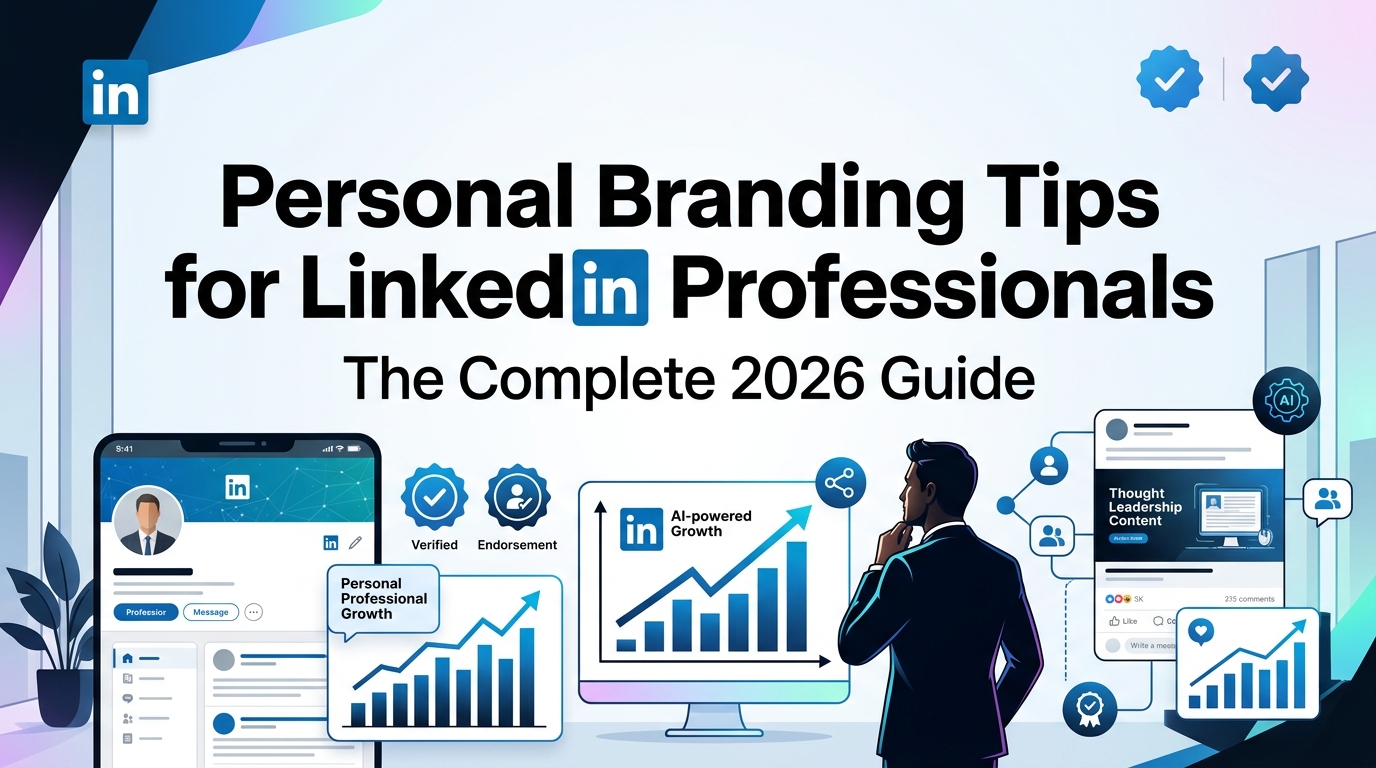
Personal branding tips for LinkedIn professionals. Learn how to build a strong LinkedIn presence, increase visibility, and position yourself as an industry expert using proven branding strategies, content optimization, and profile growth techniques.
LinkedIn is no longer just a digital resume. It has become the most powerful professional networking platform on the planet, with over one billion members and counting. If you are a professional, entrepreneur, freelancer, or job seeker and you are not actively building your personal brand on LinkedIn, you are invisible to the opportunities that could genuinely change your career.
But here is the part that most people get wrong. Personal branding on LinkedIn is not just about posting motivational quotes or updating your profile photo once a year. It is about showing up consistently, communicating your value clearly, engaging with your network meaningfully, and using every tool available — including smart AI tools for messaging, content creation, and engagement to stay visible and relevant.
A few years ago, personal branding was considered something only celebrities and CEOs needed to think about. Today, it is essential for every professional at every level.
Your LinkedIn profile is the first thing a recruiter, potential client, business partner, or employer sees when they search your name. Before they send you an email, before they pick up the phone, they have already looked you up on LinkedIn and formed an opinion. That opinion — positive or negative — is your personal brand in action.
Strong personal branding on LinkedIn helps you attract better job opportunities without actively applying, builds credibility in your industry, grows a network that actually supports your goals, positions you as a thought leader people trust, and opens doors to speaking engagements, partnerships, and consulting work.
The professionals who invest in their LinkedIn personal brand consistently report faster career growth, higher income, and more inbound opportunities than those who leave their profiles incomplete and never engage with the platform.
Your profile is your personal brand headquarters. Every element of it either adds to or subtracts from the impression you make.
Most LinkedIn users write their job title in the headline field and call it a day. "Marketing Manager at XYZ Company." That is a missed opportunity. Your headline appears everywhere on LinkedIn — in search results, in notifications, in connection requests. It needs to communicate your value, not just your title.
A strong headline follows this formula: What you do + Who you help + The result you deliver.
For example: "Helping SaaS Companies Turn Content Into Customers | B2B Marketing Strategist | LinkedIn Growth Expert"
This kind of headline immediately tells a visitor who you are, who you serve, and why they should care. It is the foundation of strong professional branding.
The About section is your opportunity to speak directly to the people you want to connect with. Write it in first person, make it conversational, and structure it around your audience's needs rather than your own achievements.
Start with a hook — a bold statement, a surprising fact, or a question that draws the reader in. Then explain who you are, what you do, and why you are uniquely positioned to help your audience. End with a clear call to action, whether that is connecting with you, visiting your website, or sending you a message.
LinkedIn functions as a search engine for professionals. Recruiters, clients, and collaborators use keywords to find people. Make sure your headline, About section, job descriptions, and skills all include the keywords your target audience would use to find someone like you.
If you are a content strategist, use terms like "content strategy," "editorial planning," "SEO writing," and "brand storytelling" naturally throughout your profile. This dramatically improves how often you appear in relevant searches.
Posting content on LinkedIn is the single fastest way to build your personal brand at scale. Every time you post, you reach not just your connections but the connections of your connections. The potential reach is enormous.
LinkedIn rewards content that sparks genuine conversation and provides real value. The formats that consistently perform well include personal stories that contain a professional lesson, actionable tip lists, behind-the-scenes looks at your work or industry, strong opinions on industry trends, and carousel posts that break down complex ideas into digestible slides.
Avoid purely promotional content, generic motivational posts without personal context, and content that has no clear takeaway for your audience. LinkedIn audiences are professionals — they want to learn something, be inspired by something real, or gain a perspective they had not considered before.
You do not need to post every day to build a strong personal brand on LinkedIn. Three to four times per week is plenty if your content is genuinely valuable. Consistency matters far more than volume. An audience that sees your name every few days will remember you. An audience that sees a burst of ten posts followed by silence for three weeks will forget you.
One of the most powerful shifts happening in LinkedIn content creation right now is the use of AI models for text generation. These tools help professionals outline posts, draft content, refine tone, and generate multiple variations of the same idea in seconds.
Tools like Claude, ChatGPT, and Jasper can help you turn a rough idea into a polished LinkedIn post without losing your authentic voice. The key is to use AI as a drafting partner, not a ghostwriter. Feed the AI your raw thoughts, review what it produces, and edit it to sound like you. The result is faster content creation without sacrificing authenticity.
Here is the truth about LinkedIn that most personal branding guides skip over. Content gets you visibility. But conversations get you opportunities.
The professionals who build the strongest personal brands on LinkedIn are not just posting great content — they are also engaging in meaningful conversations, responding to every message thoughtfully, and nurturing their network through consistent communication.
Knowing how to reply to LinkedIn messages might sound simple, but it is actually one of the most underrated skills on the platform. A great reply can turn a casual connection into a client, a recruiter into a job offer, or a stranger into a long-term collaborator.
Here are the principles of a great LinkedIn message reply. Respond within 24 hours whenever possible — speed signals that you value the connection. Personalize your response by referencing something specific about the message or the sender's profile. Be clear and concise — LinkedIn is a professional platform, and people appreciate directness. Always end with a question or a next step to keep the conversation moving forward.
For example, if a recruiter reaches out about a potential role, your reply to LinkedIn recruiter should be warm, professional, and specific. Acknowledge their message, express genuine interest if the role sounds relevant, ask a clarifying question about the position, and suggest a time to connect if appropriate. A generic "thanks for reaching out" without any engagement kills the conversation instantly.
If you receive a high volume of LinkedIn messages — which becomes common as your personal brand grows — managing responses manually can become overwhelming. This is where automatic reply LinkedIn features become genuinely useful.
LinkedIn's native Away Message feature lets you set an automatic reply that goes out to anyone who messages you during periods when you are unavailable. This is perfect for vacations, conferences, or high-focus work periods. Your automatic reply should be friendly, set clear expectations about your response time, and provide an alternative contact method if the matter is urgent.
Beyond LinkedIn's native feature, many professionals use third-party tools and CRM platforms that integrate with LinkedIn to manage high-volume messaging. These tools allow for smarter linkedin auto reply sequences that feel personal even when they are automated.
As your LinkedIn presence grows, you will find yourself sending similar types of replies over and over. Responses to connection requests, replies to people asking about your services, thank-you messages after someone engages with your content. A text reply generator or text response generator can help you create templates for these common scenarios that you can personalize and send quickly.
Tools built specifically for LinkedIn messaging help you maintain the quality and warmth of your responses even when the volume is high. The best approach is to create a library of response templates for your most common message types, then personalize each one with the recipient's name, their company, or a specific reference to their message before sending.
We are living in the golden age of AI-powered productivity tools for professionals. If you are building a personal brand on LinkedIn in 2026 and you are not using these tools, you are working significantly harder than you need to.
Social proof is one of the most powerful elements of personal branding. When potential clients, employers, or collaborators see that other people trust and recommend you, their confidence in you grows dramatically. An AI review generator can help you draft recommendation requests to send to former colleagues, clients, and managers — making it easy for them to write a glowing testimonial without staring at a blank page.
You can also use AI tools to help you write your own recommendation letters for people in your network. Giving before you receive is a powerful personal branding strategy on LinkedIn, and AI makes it faster and easier to give genuinely thoughtful recommendations.
One of the fastest ways to grow your LinkedIn personal brand is to engage meaningfully with other people's content. When you leave a thoughtful, substantive comment on a post by someone in your industry, you expose yourself to their entire audience — potentially thousands of people who have never heard of you.
A discussion response generator can help you craft responses that add genuine value to conversations rather than generic "Great post!" comments that no one notices. The best AI tools for this can take the context of a post and suggest multiple angles for a response — a contrarian perspective, an additional data point, a personal story that connects to the theme, or a question that deepens the discussion.
Many LinkedIn conversations eventually move to email, especially when discussing business opportunities, job offers, or collaborations. Using an AI email writer like Mailmeteor or similar tools helps you craft professional, compelling follow-up emails that maintain the momentum of a LinkedIn conversation.
A good Mailmeteor AI email writer or similar tool can help you draft reply to email confirmation messages that are clear and professional, personalized outreach emails that feel warm and specific, follow-up sequences that nurture relationships over time, and proposal emails that clearly communicate your value.
The combination of LinkedIn messaging and smart email follow-up is one of the most effective relationship-building strategies available to professionals today.
Several LinkedIn messaging tools and AI writing assistants now offer predicting sentence capabilities — where the tool anticipates what you are about to write and completes your sentence for you. This sounds small, but when you are sending dozens of messages a day, these time savings add up significantly.
Gmail's Smart Compose feature pioneered this concept, and similar technology is now being integrated into LinkedIn messaging tools and third-party productivity apps. The result is faster, smoother communication — with your reply LinkedIn messages going out quicker and sounding more polished than ever before.
Your LinkedIn network is only as valuable as the relationships within it. Having ten thousand connections means nothing if none of them know who you are or what you do.
Many professionals make the mistake of sending connection requests to as many people as possible, treating LinkedIn like a numbers game. This approach fills your network with strangers who will never engage with your content, never respond to your messages, and never become real opportunities.
Instead, connect with people who are genuinely relevant to your goals. This means people in your industry, potential clients, collaborators, mentors, and peers at your level or slightly above. When you send a connection request, always include a personalized note explaining why you want to connect. A simple, specific message dramatically increases your acceptance rate and starts the relationship on the right foot.
Building a network is not a one-time activity. It requires consistent nurturing. This means engaging with your connections' content regularly, congratulating them on milestones, sharing relevant articles or resources that might help them, and checking in periodically with people you have not spoken to in a while.
The professionals with the strongest personal brands on LinkedIn are consistently generous with their attention, knowledge, and support. This generosity compounds over time into a reputation for being helpful, knowledgeable, and genuinely invested in the success of others.
LinkedIn Groups are an underutilized opportunity for personal brand building. By joining groups where your target audience gathers and contributing meaningfully to conversations, you build visibility and credibility with exactly the people you want to reach.
Choose groups that are active and relevant to your niche. Participate by answering questions, sharing insights, and starting discussions — not by promoting your services. The goal is to become a recognized, trusted voice in the community. Opportunities will follow naturally.
Personal branding on LinkedIn is not a set-it-and-forget-it activity. It requires ongoing attention, measurement, and refinement.
LinkedIn's analytics tools give you valuable data about how your content is performing. Pay attention to which posts generate the most impressions, which drive the most profile views, and which result in the most connection requests or messages. This data tells you what your audience values most, and you should create more of it.
Look at your profile analytics as well. Track how many people are viewing your profile each week, where they are coming from — search, content, or direct — and what keywords are bringing them to you.
If you notice that your personal story posts consistently outperform your tips-based posts, lean into storytelling. If your carousel posts get more saves and shares than your text posts, create more carousels. Let the data guide your content decisions rather than following generic advice that may not apply to your specific audience and industry.
This is the hardest part of LinkedIn personal branding, and it is also the most important. The professionals who see the most dramatic results are not necessarily the most talented writers or the most experienced experts. They are the ones who show up consistently, week after week, month after month, regardless of whether a particular post performs well or falls flat.
Personal branding is a long game. The investment you make today — in your profile, your content, your relationships, and your skills — compounds over months and years into a professional reputation that opens doors you cannot even see yet.
Once you have the fundamentals in place, these advanced strategies can take your LinkedIn personal brand to the next level.
LinkedIn's native article and newsletter features allow you to publish long-form content directly on the platform. This content is indexed by Google, giving you SEO benefits beyond LinkedIn itself. A well-written LinkedIn newsletter with a consistent publishing schedule can build a subscriber base of thousands of engaged readers who receive your content directly in their notifications.
Co-creating content with other professionals in your field or adjacent fields is one of the fastest ways to grow your audience. When you collaborate on a post, a LinkedIn Live session, or a newsletter feature, you expose yourself to each other's audiences. Look for collaborators whose expertise complements yours and whose audience overlaps with the people you want to reach.
LinkedIn Live is still relatively underused by most professionals, which means it represents a significant opportunity right now. Going live for a 20-to-30-minute session where you share insights, answer questions, or interview a guest consistently generates massive reach compared to standard posts. The barrier to starting a LinkedIn Live is low — all you need is a topic, a stable internet connection, and the willingness to show up on camera.
A simple but often overlooked personal branding step is customizing your LinkedIn URL. Instead of the default string of numbers LinkedIn assigns you. This looks more professional in email signatures, on business cards, and anywhere else you share your LinkedIn profile.
Even well-intentioned professionals make these mistakes. Knowing them in advance can save you months of wasted effort.
Trying to appeal to everyone. The most effective personal brands are specific. The more clearly you define your audience and niche, the more powerfully your brand resonates with the people who matter most to your goals.
Posting without engaging. LinkedIn is a two-way platform. If you post content but never respond to comments, never engage with others' posts, and never reply to messages, your growth will stall. Even using a simple text response generator to speed up your replies is better than leaving messages unanswered for days.
Being inconsistent. Posting ten times in one week and then disappearing for three weeks destroys the momentum you have built. Commit to a realistic, sustainable posting schedule and stick to it.
Copying others' voices. Your personal brand is built on your authentic perspective and experience. If you try to mimic another creator's style or simply repost others' content without adding your own perspective, you give people no reason to follow you specifically.
Neglecting your inbox. Many professionals focus entirely on content creation and forget that their LinkedIn messages are full of opportunities sitting unanswered. Whether you use a text reply generator, set up an automatic reply LinkedIn message, or simply block time each day to respond manually, make inbox management a non-negotiable part of your LinkedIn routine.
In 2026, your personal brand on LinkedIn is not a nice-to-have. It is your most important professional asset. It is what gets you found, what builds trust before the first conversation, and what creates opportunities that cold applications and cold outreach never could.
The tools available today — from AI models for text generation that speed up content creation, to smart linkedin auto reply and text response generator tools that help you manage your inbox efficiently, to AI review generator platforms that help you build social proof, to discussion response generator tools that help you engage more meaningfully — have made it easier than ever to build a powerful personal brand without burning out.
Knowing how to reply to LinkedIn messages strategically, setting up automatic reply LinkedIn sequences during busy periods, using a mailmeteor AI email writer for follow-ups, and leveraging predicting sentence technology for faster communication — these are not shortcuts. They are smart professional habits that free up your time for the work that truly matters: building genuine relationships and sharing your authentic expertise with the world.
Start with clarity about who you are, who you serve, and what value you uniquely bring. Build a profile that reflects that clarity. Create content that demonstrates it. Build relationships that amplify it.
How long does it take to build a strong personal brand on LinkedIn? Most professionals start seeing meaningful results — increased profile views, more connection requests, inbound messages from relevant people — within three to six months of consistent effort. A strong, recognizable personal brand typically takes 12 to 18 months to establish fully.
Should I use my personal LinkedIn profile or create a company page? Both serve different purposes. Your personal profile is where your personal brand lives — it is where people connect with you as an individual. A company page is for your business. For personal branding, always lead with your personal profile.
How do I handle negative comments on my LinkedIn posts? Respond professionally and calmly. Never delete critical comments unless they are abusive or violate LinkedIn's community standards. A thoughtful, gracious response to a critical comment actually enhances your personal brand by demonstrating confidence and emotional intelligence.
Is it worth paying for LinkedIn Premium for personal branding? LinkedIn Premium provides valuable features including InMail credits, profile view insights, and advanced search filters. For serious personal brand builders, it is worth the investment. However, you can build a strong personal brand entirely on the free plan — especially if you focus on content creation and genuine engagement.
How often should I update my LinkedIn profile? Review and update your profile at least every six months. Update it immediately whenever you change roles, complete a significant project, earn a new certification, or want to shift the focus of your personal brand.

Rachel Stanton is a tech writer who specialises in AI productivity tools for busy professionals. He tests and reviews the latest AI software so you can make smarter decisions about where to invest your time and money.
AIReplyBee is your AI-powered LinkedIn reply generator that helps you create authentic, engaging responses in seconds.
Generate your first replyWhat is a collaboration post? Learn how Instagram collab posts work, why they boost reach, and how to set one up step-by-step.
InMail on LinkedIn lets you message anyone, even outside your network. See how it works, pricing, credits, and tips to boost replies.
Learn how to use ChatGPT effectively with the PTCF framework, 7 practical steps, and a real before/after example that actually works.