The best lead generation tools for small businesses in 2026 are HubSpot (free CRM with built-in lead capture), Apollo.io ($49/month for outbound prospecting), and Leadpages ($49/month for landing pages). Most small businesses can run a complete capture-to-nurture stack for under $100 per month. The right choice depends on one thing: whether your leads come to you or you go find them.
Now let me be blunt with you.
Most lists of the best lead generation tools for small businesses are written by companies selling lead generation tools. Which is a bit like asking a barber whether you need a haircut.
So I did something different. I pulled the actual benchmark data, cross-checked pricing across a dozen sources, and built the shortlist I'd hand to a friend running a five-person business.
Let's get into it.
HubSpot's free CRM is the best starting layer for almost every small business — it includes forms, popups, live chat, and landing pages at $0.
Small business cost per lead (CPL) now averages $58, up 23.4% year over year.
B2B contact databases advertise 90–95% accuracy; the real industry ceiling is 70–85%.
True total cost of ownership runs 3–5× the advertised price once setup, integrations, and expiring credits are counted.
You can build a complete lead generation stack for under $100/month — three options are below.
Responding within 5 minutes makes you 21× more likely to qualify a lead than waiting 30 minutes.
Before we talk products, we need to talk about why this goes wrong so often. And it goes wrong a lot. The pattern I see is almost always the same: a business owner reads a listicle, buys a 275-million-contact database, uses it twice, and quietly cancels four months later. The tool wasn't bad. The match was. Your lead generation strategy should pick the tool — never the other way around.
Here's the number that should make you pause.
According to Forrester's B2B benchmark data covering 3,800 companies, small businesses with fewer than 50 employees now see a cost per lead of $58 — a 23.4% jump, driven by more competition on local ad platforms and shrinking organic reach.
Meanwhile, nearly 78% of small businesses spend between $100 and $1,000 per month generating leads.
Do that math. Your entire monthly budget might buy you two to seventeen leads.
That's why tool selection isn't a shopping decision. It's a survival decision. (If your traffic is the real bottleneck, start with our guide to local SEO for small businesses before you buy anything here.)
Advertised pricing is fiction. I say that with love, but I mean it. One teardown of 25 platforms found that true total cost of ownership runs three to five times the sticker price once you count setup time, integration work, expiring credits, and the forced upgrade that hits the moment you get traction. Worse, that same analysis found 2026 pricing climbing 20–30% year over year. So budget for reality, not for the pricing page.
And here's the one that stings.
B2B contact databases advertise 90–95% accuracy. Independent benchmarks put the real ceiling at 70–85%.
That means one in five contacts you pay for is wrong. Plan your outreach volume accordingly.
Okay. Deep breath. Before you compare features, you need a filter — otherwise every tool looks essential, because every tool is designed to look essential. I use four questions, and they've never failed me. They cut a 35-tool list down to about three in under ten minutes. Run your shortlist through these before you enter a credit card anywhere, because the fastest way to waste money on lead capture software is buying it enthusiastically.
Question one: what's your primary motion? Inbound (people find you) or outbound (you find them)? These need completely different tools.
Question two: what's your traffic? Under 1,000 monthly visitors, a conversion optimization platform is premature. You don't have a conversion problem. You have a traffic problem.
Question three: does it talk to your CRM? Integration complexity quietly kills more stacks than pricing does. Our CRM comparison for small teams covers this in depth.
Question four: what happens at the ceiling? Every free tier stops somewhere. Find out where before you build a workflow on top of it.
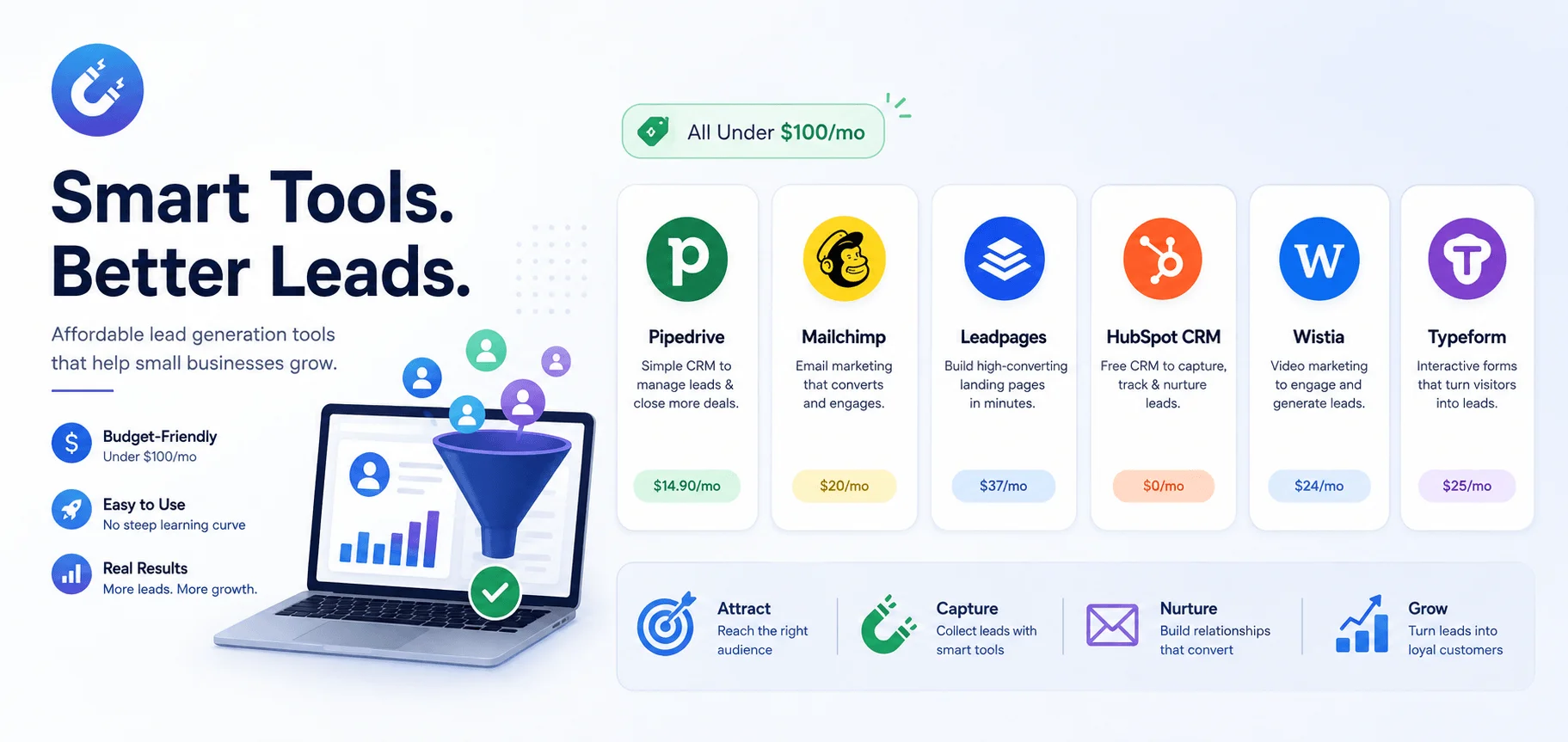
Right — the main event. I've grouped these by job rather than ranking them 1 through 25, because a ranked list implies tool #1 beats tool #7 for everyone, and that's simply not true. An email finder tool and a landing page builder aren't competitors. They're teammates. Here's the full comparison first, then the detail underneath.
Tool | Best For | Free Tier | Starting Price | Key Limitation |
|---|---|---|---|---|
HubSpot | All-in-one CRM + capture | Yes, ongoing | $20/month | Caps at 1,000 contacts |
Apollo.io | B2B outbound prospecting | Yes, 10,000 credits | $49/month/user | Data accuracy ceiling ~85% |
Hunter.io | Email finding & verification | 25 searches/month | $49/month | Email data only, thin firmographics |
Leadpages | Landing pages & popups | 14-day trial | $49/month | A/B testing locked to $99 tier |
Carrd | Ultra-budget landing pages | Yes, limited | $19/year | Minimal customization |
Unbounce | Paid-ads landing pages | 14-day trial | $99/month | Overkill under $2k ad spend |
OptinMonster | Exit-intent popups | No | $16/month | No email sending built in |
Brevo | Free email nurture | Yes, ongoing | $9/month | Daily send caps on free plan |
ActiveCampaign | Behavior-based automation | 14-day trial | $15/month | Basic CRM, email-first only |
Calendly | Booking captured leads | Yes, ongoing | $10/month | One event type on free plan |
Pricing verified August 2026. Vendors change pricing frequently — confirm before purchasing.
I recommend HubSpot's free CRM more than any other single tool, and it's not close. The free tier includes form builders, popup forms, live chat, a chatbot builder, and landing pages. That's genuine lead capture — not just storage.
The ceiling: 1,000 contacts. After that, pricing climbs by marketing contacts, and it climbs faster than most people expect.
If you're doing cold outreach, Apollo.io is the consensus budget pick. You get 275M+ contacts, filtering by title, industry, company size and intent data, plus built-in sequences and a dialer — so you go from list to outreach without leaving the platform.
One warning: cold email outreach has a discipline problem. A Gartner survey found 73% of B2B buyers actively avoid suppliers who send irrelevant outreach. Fifty targeted contacts beat five hundred sloppy ones. Every single time. The same trap catches people on social — we broke down the most common ones in LinkedIn outreach automation mistakes.
Small, focused, does one thing beautifully. Hunter.io finds and verifies email addresses at target domains, which protects your deliverability and keeps your bounce rate low.
Pro move: run contacts through both Apollo and Hunter. If both return the same address, you can send with confidence.
Leadpages gives you unlimited landing pages and pop-ups at $49/month, with A/B testing on the $99 tier. You'll have a professional page live in under an hour, no developer required.
Carrd costs $19 per year. Not per month. Per year. Limited, but unbeatable for speed.
Unbounce routes traffic to your highest-converting variant automatically. Worth it once you're spending real money on ads — and pairs well with our landing page optimization checklist.
OptinMonster is the exit-intent popup specialist. It detects when someone's about to leave and shows a targeted offer at that exact moment. The targeting rules are the real product: different offers by traffic source, by page, by visit count.
Brevo is the strongest free option for email marketing software. ActiveCampaign wins on behavior-based automation and lead scoring, though its CRM stays fairly basic. Either handles your drip campaign work fine. If you're writing those five nurture emails from scratch, an AI email generator will cut the drafting time significantly.
Calendly turns a captured lead into a booked meeting in one click. Underrated as a lead generation platform component, because it removes the highest-friction step in your funnel. The harder part is earning the meeting in the first place — this guide on turning replies into booked sales calls covers the conversation that comes before the calendar link.
Here's where I get practical. You don't need eleven tools, and you almost certainly shouldn't have eleven tools — every integration is a place where things break silently at 2am. Below are three stacks built around the three most common small business situations I run into. Pick the one that describes you, ignore the other two, and resist the urge to add "just one more" platform for at least ninety days.
Carrd ($19/year) + HubSpot free CRM + Tidio chat + an optimized Google Business Profile. Total: about $50/month.
Apollo.io ($49/month) + Hunter free tier + HubSpot free CRM. Total: $49/month.
Leadpages ($49/month) + OptinMonster ($16/month) + Brevo free tier. Total: $65/month.
Notice what's missing? Enterprise databases. Marketing automation platforms costing hundreds a month. AI SDR agents.
You'll grow into those. You don't start there.
Tools without a system are just expensive bookmarks. So let's build the system. This is deliberately aggressive — one week, start to finish — because momentum matters more than perfection here. You can refine everything later, but you can't refine something that doesn't exist. Block ninety minutes a day and follow along in order, since each step depends on the one before it.
Day 1 — Define your ideal customer profile (ICP). Company size, industry, location, and the trigger that makes someone need you. Everything downstream depends on this.
Day 2 — Build one lead magnet. A checklist, template, or calculator. Content downloads convert at 40–60% MQL rates versus 5–15% for contests.
Day 3 — Build your landing page. One page. One offer. Four form fields maximum.
Day 4 — Connect your CRM. Wire the form to HubSpot. Test it. Then test it again from your phone.
Day 5 — Write a five-email nurture sequence. Nurtured leads make purchases 47% larger than non-nurtured ones.
Day 6 — Set up your response system. Respond within 5 minutes and you're 21× more likely to qualify the lead than at 30 minutes. Notifications on. Owner assigned.
Day 7 — Drive your first 100 visitors. Existing list, social, or a small paid test. Then measure.
You'll be tempted to track everything. Don't. Measuring marketing ROI is the single biggest challenge marketers report in 2026, at 33%, ahead of platform changes and lead generation itself. The teams that solve it aren't tracking more — they're tracking less, and tracking it consistently. These four numbers tell you whether your stack is earning its keep.
Cost per lead (CPL) — total spend divided by leads generated. Small business benchmark: $58.
Lead-to-customer conversion rate — what share of leads actually buy.
Customer acquisition cost (CAC) — full cost to win one paying customer.
Speed-to-lead — minutes from inquiry to first human contact. Target: under 5.
And prioritize quality relentlessly. 68% of B2B marketers say improving lead quality — not volume — is their top priority, which makes sense when roughly 80% of new leads never convert and 44% of reps never follow up at all.
More leads won't fix a follow-up problem.
Short answer: yes, but narrowly. AI is genuinely useful in this category right now — just not in the way the ads suggest. The wins are unglamorous: scoring, enrichment, routing, summarization. The losses tend to be the flashy, fully-autonomous stuff. Knowing which side of that line a tool sits on will save you a five-figure mistake, so here's the honest split based on where the data currently sits.
AI-scored leads convert at roughly 75% higher rates than rules-based scoring, and those tools now start around $49/month. 64% of businesses using AI chatbots report more qualified leads.
Fully autonomous AI SDR agents run $24,000–$60,000 per year, and most deployments have quietly reverted to hybrid human-AI use.
Use AI to prioritize and enrich. Keep a human on the relationship.
HubSpot's free CRM is the best free option because it includes form builders, popup forms, live chat, a chatbot builder, and landing pages — genuine lead capture, not just storage. It supports up to 1,000 contacts. Brevo is the best free choice for email nurture, and Apollo.io's free tier is the strongest for B2B prospecting.
Most small business lead generation tools cost $16 to $99 per month individually. A complete working stack runs $49 to $80 per month. Budget for 3–5× the advertised price once setup, integrations, and expiring credits are counted, since 2026 pricing has climbed 20–30% year over year.
The 2026 benchmark for businesses under 50 employees is $58 per lead, up 23.4% year over year. Blended cross-industry averages sit near $200–$213, but that figure is skewed by enterprise spending. Webinars are the cheapest high-quality channel at roughly $72 per lead.
Not necessarily at the start. HubSpot's free tier combines both, so one tool covers capture and storage. You'll want to separate them once you outgrow 1,000 contacts or need specialized capture — like exit-intent popups or high-volume outbound prospecting.
Yes, for scoring and enrichment. AI lead scoring converts roughly 75% better than rules-based scoring and starts near $49/month. Skip fully autonomous AI SDR agents — they cost $24,000–$60,000 per year and most deployments have reverted to hybrid human-AI workflows.
Vendors advertise 90–95% accuracy, but independent benchmarks put the real ceiling at 70–85%. Roughly one in five contacts you pay for will be wrong. Cross-reference two tools — if Apollo and Hunter return the same address, confidence is high.
Here's what I'd want you to take away.
The best lead generation tools for small businesses aren't the ones with the biggest databases or the longest feature lists. They're the ones that match your motion, fit inside a budget you can sustain for twelve months, and don't collapse the moment you hit a credit limit.
Start with the free HubSpot layer. Add one capture tool. Add one nurture tool.
Then — and only then — spend money on volume.
Because a bad lead generation stack doesn't just waste your budget. It teaches you the wrong lessons about your market, and those take a lot longer to unlearn.

Daniel Harper is a B2B marketing consultant who helps professionals and founders grow their LinkedIn presence through smart engagement strategies. He writes about AI tools, reply tactics, and building authentic professional networks that actually convert.
AIReplyBee is your AI-powered LinkedIn reply generator that helps you create authentic, engaging responses in seconds.
Generate your first replyWhat is a collaboration post? Learn how Instagram collab posts work, why they boost reach, and how to set one up step-by-step.
InMail on LinkedIn lets you message anyone, even outside your network. See how it works, pricing, credits, and tips to boost replies.
Learn how to use ChatGPT effectively with the PTCF framework, 7 practical steps, and a real before/after example that actually works.