The best time to post on LinkedIn is Tuesday through Thursday, between 10 AM and 2 PM in your audience's local time zone. Wednesday is the single strongest day across every major 2026 dataset. Weekends are the worst — engagement drops sharply on Saturday and Sunday because LinkedIn is a professional network and people log off.
That's the answer. Now here's the part nobody else will tell you.
When I read the four biggest 2026 studies side by side — Buffer, Sprout Social, Hootsuite, and LinkedIn's own marketing blog — I found they contradict each other by a full ten hours.
One says 8 AM. One says 4 PM. One says engagement dies after 2 PM.
So in this guide, I'll show you what each study actually found, why they disagree, and how you can find your own optimal posting time instead of copying a chart.
Best days: Wednesday, then Thursday and Tuesday
Best window: 10 AM–2 PM local time (consensus overlap of all four studies)
Worst days: Saturday and Sunday — no study recommends them
Biggest 2026 shift: Buffer found late afternoon and evening (3–8 PM) now outperform mornings
What matters more than timing: posting frequency and dwell time, by a wide margin
Before I get into the weeds, let me give you the honest consensus. Because if you only read one section, this is it. Across every dataset I reviewed, one pattern held: midweek beats early week, weekdays crush weekends, and the middle of the workday is a safe default. That said, the "exact hour" is where things get messy — and where most guides quietly fudge the truth. Here's the real breakdown.
Sprout Social based its numbers on nearly 2 billion engagements across 307,000 social profiles, collected between late November 2025 and late February 2026. That's an enormous sample.
Their verdict? Tuesdays 11 AM–5 PM. Wednesdays 11 AM–4 PM. Thursdays at 11 AM plus 1–5 PM.
Buffer looked at 4.8 million posts and landed somewhere else entirely.
And Hootsuite, partnering with Critical Truth across 1 million posts and 118 countries, landed somewhere else again.
Which brings me to the fun part.
I want you to see this properly, because it changes how you read every "best time to post" article on the web — including this one. Most posts cherry-pick whichever study supports the headline they already wrote. I'd rather show you the whole picture. Below is what each dataset concluded, in plain language, with no smoothing over the awkward bits.
Study | Sample size | Best day | Best hours |
|---|---|---|---|
Buffer | 4.8M posts | Wednesday | 3 PM–8 PM |
Sprout Social | ~2B engagements | Tuesday | 11 AM–5 PM |
Hootsuite | 1M+ posts | Tuesday/Wednesday | 8 AM–9 AM |
LinkedIn (official) | Partner studies | Thursday/Friday | 9 AM–5 PM |
Look at those hours. That's a ten-hour spread.
So what's going on? Three things, and they matter.
First, different populations. Buffer's data comes from posts scheduled through Buffer — a lot of creators and small businesses. Sprout's data skews toward brand pages and enterprise teams. Those audiences behave differently.
Second, different clocks. Buffer normalizes its times so 4 PM means 4 PM wherever you are. Sprout also reports local time, but from a completely different profile mix.
Third — behavior actually shifted in 2026.
This is the finding I keep coming back to, and I think it's the most useful thing here. For years the advice was simple: post during business hours, because people scroll LinkedIn at their desks. That was true. It's apparently getting less true. Buffer's year-over-year comparison caught the change, and once you see it, the disagreement between studies starts to make sense.
In 2025, Buffer found peak engagement was almost entirely confined to working hours. Things fell off a cliff after 5 PM.
In 2026? Those peak windows moved later.
Late afternoon and evening — roughly 3 PM to 8 PM — now pull some of the strongest LinkedIn engagement numbers Buffer has recorded. Their single best slot is Wednesday at 4 PM, followed by Friday at 3 PM and 4 PM.
Buffer's theory: people engage after they close their laptops. On the commute. During the evening wind-down.
It mirrors what already happened on Instagram and TikTok.
But Sprout Social, using a bigger dataset, says the opposite — engagement drops after 2 PM as professionals wrap up.
Both can't be right for your audience. Which is exactly why the rest of this guide focuses on finding your number.
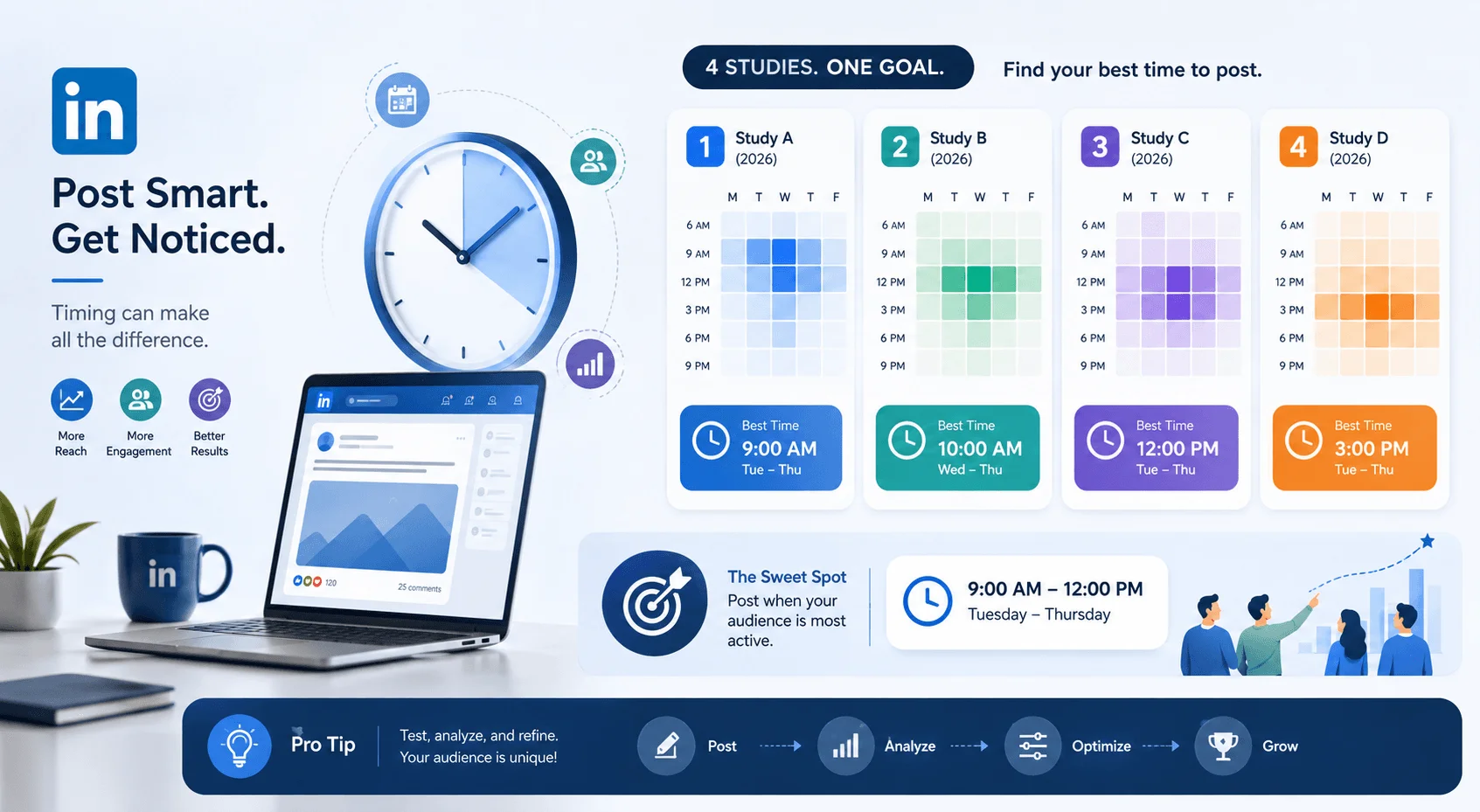
Let's get tactical. Even though the studies disagree on the hour, a day-by-day view gives you a workable starting schedule. I've pulled the day-level recommendations below and noted where they clash. Treat this as a hypothesis to test, not gospel. Your first job is to pick a slot; your second is to prove or disprove it with your own numbers.
Monday — Sprout says 1–2 PM. Hootsuite says 11 AM. Buffer found 10 PM and ranked Monday the weakest day of the week. Don't waste your best post here.
Tuesday — Sprout's strongest day, 11 AM–5 PM. Hootsuite says 6–8 AM. LinkedIn says 4 PM. Loudest disagreement of the week, so test aggressively.
Wednesday — Near-universal agreement. Buffer's best day. Sprout: 11 AM–4 PM. Hootsuite: 9 AM. LinkedIn: 2 PM. If you optimize one day, optimize this one.
Thursday — Strong across the board. Sprout: 11 AM and 1–5 PM. Hootsuite: 2 PM. Good for thought leadership and longer content.
Friday — Underrated. Buffer ranks it top-three with 3 PM as the sweet spot. Sprout narrows it to 11 AM and 1–2 PM, calling Friday engagement "a sprint, not a marathon."
Saturday and Sunday — Sprout's position is blunt: no optimal times exist. Post on a Saturday and you're speaking to an empty room.
Your industry changes the answer more than most people realize. A hospital administrator and a software engineer have completely different daily rhythms, and your LinkedIn posting schedule should reflect that. Sprout broke this out across eight sectors, and the variation is significant — in some cases a three-hour swing from the global average. If your niche is listed, weight these over the general recommendation.
Technology and software — Tuesdays and Wednesdays, 10 AM–4 PM
Financial services — Tuesdays and Wednesdays, 10 AM–3 PM, plus 8 AM spikes midweek for pre-market research
Healthcare — Wednesdays 11 AM–5 PM, Thursdays 9 AM–4 PM
Retail — Thursdays 8 AM–3 PM
Government — Thursdays 10 AM–5 PM
Nonprofits — Tuesday to Thursday, 10 AM–4 PM (you're reaching sponsors, not the public)
Education — Tuesdays 10 AM–5 PM
Worth noting: Hootsuite's industry data disagrees here too, putting technology's peak at 11 AM on Mondays. Again — test.
If your audience sits outside your own country, everything above needs shifting. This is the section most guides skip entirely, which is odd, because it's where the biggest mistakes happen. Hootsuite localized its data across 118 countries and published zone-level peaks, and the spread is wide enough to completely invalidate a generic schedule. Here's where each major zone lands.
GMT — 7 AM to 9 AM on Thursdays
CET — 7 PM on Thursdays
EST — 5 AM Tuesdays; 6 AM and 5 PM Thursdays; 8 AM and 6 PM Fridays
CST — early Tuesday mornings (before 6 AM), 6 AM Thursdays, 4 PM Fridays
MST — 5 AM and 3 PM on Thursdays and Fridays
PST — 2 PM to 4 PM on Thursdays and Fridays
For Asia-Pacific audiences, Sprinklr recommends mid-morning, around 9–11 AM local, which aligns with workday starts and pre-meeting browsing.
A practical trick if you're targeting multiple regions: find the overlap. A 9 AM Pacific post also lands at noon Eastern and early evening in Europe.
Format changes the answer too, because different content demands different amounts of attention. A carousel needs someone with a spare two minutes. A text post can be consumed in a scroll. Matching your format to the mental state of your reader is an easy win that costs you nothing. Here's how the formats break down.
Carousels and documents — midday, roughly 11 AM–2 PM, when people have a real break
Native video — 12–2 PM and 5–7 PM; video needs dwell time, so lunch and the post-work scroll work best
Text posts — mid-morning, when people are skimming between tasks
Polls — early week, when the workweek framing feels natural
Now let me push back on my own article. Because there's a version of this topic that's pure superstition, and I don't want you thinking 4 PM Wednesday is a magic button. Timing works for a specific mechanical reason, and that reason has limits. Understanding both halves will save you from obsessing over minutes when you should be fixing your hook.
The LinkedIn algorithm uses interactions — reactions, comments, reposts — as signals to decide which posts deserve wider distribution.
SocialBee describes the golden hour as the first 60 to 90 minutes after publishing, when early engagement influences whether LinkedIn expands your audience.
Buffer is more skeptical, and rightly so. There's no official 60- or 90-minute window confirmed by LinkedIn. What LinkedIn has said is that early engagement signals can influence distribution. That's a meaningful difference.
LinkedIn introduced suggested posts in 2024 — a feature that keeps high-quality content visible long after publishing, prioritizing relevance and expertise over recency.
Hootsuite's algorithm research confirms early engagement gives your post a nudge, but it isn't the whole game. Posts can resurface in feeds days or even weeks later.
Translation: a great post at a bad time still has a shot. A bad post at 4 PM Wednesday does not.
This is the signal quietly running the show now. Posts that hold attention for 60+ seconds see engagement rates around 15.6%, compared to about 1.2% for posts getting under 3 seconds.
Replying to comments within the first hour reportedly produces around a 35% visibility boost.
So your hook matters more than your clock.
If you gave me one lever to pull for your LinkedIn reach, it wouldn't be timing. The data on these two is far more decisive, and the effect sizes aren't close. Sort these out first, then come back and fine-tune your schedule. Buffer analyzed over 2 million posts to establish the frequency numbers below.
Once per week — the baseline. Below the threshold where LinkedIn treats you as consistently active.
2–5 posts per week — roughly 1,182 more impressions per post and a 0.23 percentage point lift in engagement rate versus posting once weekly.
6–10 posts per week — around 5,001 additional impressions per post.
11+ posts per week — nearly 17,000 more impressions per post and roughly triple the engagements.
Critically, these gains hold whether you have 500 followers or 50,000.
No posting time on earth gives you a 17,000-impression swing. If you're building a schedule from scratch, this guide to LinkedIn posting for solo founders walks through cadence in practice.
On format: Buffer's data shows carousel and document posts generate up to 596% more engagement than text-only posts. Though — and I love this — Sprout's 2026 report found 51% of users say they prefer interacting with text-based posts.
People say one thing and do another. Classic.
Enough theory. This is the section I'd bookmark. Every study I've cited ends with the same disclaimer — your audience is unique — then nobody explains how to act on it. So here's the process I'd follow, using free tools. It takes about three weeks to get a usable answer, and you only have to do it properly once.
Step 1: Start logging your post times.
Non-negotiable, because LinkedIn Analytics won't show detailed timestamps after the fact. The best you'll get is "3h" or "2d." Use a spreadsheet or a social media scheduling tool that keeps a record.
Step 2: Pull your post-level data.
Open your LinkedIn Page, go to the Analytics tab, select Content, then choose Engagement rate under Metrics. Export it.
Step 3: Check your follower time zones.
Under Followers, you'll see location and industry data. If most of your audience sits in a different zone than you, revisit the time-zone section above.
Step 4: Test three slots for three weeks.
Pick one morning slot, one midday slot, one late-afternoon slot. Post consistently. Don't change formats mid-test or you'll muddy the data.
Step 5: Post a few minutes off the hour.
Small trick from Hootsuite: most brands schedule on the :00 mark. Publishing at 10:07 instead of 10:00 dodges some of that competition.
Step 6: Show up in the comments.
Whatever slot you choose, be available for the first hour. It's the highest-leverage thing you can do after hitting publish — and the same timing logic applies to when you comment on other people's posts.
Here are the questions I get asked most often about LinkedIn posting times, answered as directly as I can. If you've skimmed the guide, this section covers the practical gaps. Each answer reflects the 2026 data above rather than recycled advice from older studies, and where the sources genuinely conflict, I've said so instead of picking a side.
It depends whose data you trust. Sprout Social says morning and midday, with engagement dropping after 2 PM. Buffer's 2026 analysis found the reverse — evening posts between 3 PM and 8 PM now outperform mornings. Test both windows with your own audience before committing.
Yes, but less than most guides claim. Because the algorithm uses early engagement to decide distribution, posting when your audience is active gives your post a stronger start. However, LinkedIn's suggested posts feature keeps quality content visible for days or weeks, so timing is a boost — not a rescue.
Saturday and Sunday are the worst days across every study. Sprout Social found no optimal weekend times at all. Buffer additionally ranks Monday and Tuesday as the weakest weekdays, with morning hours before noon now underperforming.
Tuesday through Thursday, 10 AM to 2 PM local time. B2B decision-makers engage during core business hours when they're researching solutions and reading thought leadership. For software and technology specifically, Sprout found Tuesdays and Wednesdays 10 AM–4 PM strongest.
Start at 2–5 times per week. Buffer's analysis of 2 million posts found that cadence delivers about 1,182 more impressions per post than posting once weekly. Pushing to 11+ posts per week produces nearly 17,000 more impressions per post, regardless of follower count.
Generally no. Engagement drops sharply because most people treat LinkedIn as a weekday platform. If you must, Buffer found Saturday at 9 AM and Sunday around 10 PM show the most weekend activity — but both trail every weekday.
Start with Wednesday between 10 AM and 2 PM. It's the closest thing to a consensus that exists, and it's a perfectly good default.
Then run the six-step test above and replace that guess with your own number.
Because the honest answer to "when should you post on LinkedIn" isn't a time. It's a habit: post consistently, in a format that holds attention, and be there when people reply.
The clock is the smallest part of it.

Daniel Harper is a B2B marketing consultant who helps professionals and founders grow their LinkedIn presence through smart engagement strategies. He writes about AI tools, reply tactics, and building authentic professional networks that actually convert.
AIReplyBee is your AI-powered LinkedIn reply generator that helps you create authentic, engaging responses in seconds.
Generate your first replyWhat is a collaboration post? Learn how Instagram collab posts work, why they boost reach, and how to set one up step-by-step.
InMail on LinkedIn lets you message anyone, even outside your network. See how it works, pricing, credits, and tips to boost replies.
Learn how to use ChatGPT effectively with the PTCF framework, 7 practical steps, and a real before/after example that actually works.