how to write LinkedIn outreach messages that spark conversations and generate more replies in 2026. This guide includes proven templates for networking, lead generation, recruiting, partnerships, and sales outreach.
Most LinkedIn outreach messages get ignored, and it's rarely because the sender picked the wrong person to contact. It's because the message itself reads like it was sent to five hundred people at once, which, increasingly, it was. As AI-assisted outreach tools have made it easier than ever to send more messages faster, reply rates have quietly dropped across the board, precisely because recipients have gotten much better at spotting a generic template the moment it lands in their inbox.
This guide covers what actually works in 2026: real LinkedIn outreach message templates you can adapt today, the LinkedIn connection message template structures that consistently outperform generic asks, and an honest look at the growing ecosystem of AI tools from LinkedIn AI agents to Chrome extensions for LinkedIn that can genuinely help you scale outreach without sounding like everyone else doing the same thing. We'll also touch on why Google's June 2026 spam update matters here, even though it's a search algorithm update, not a LinkedIn one. The same principle it enforces is exactly what separates outreach that gets replies from outreach that gets ignored.
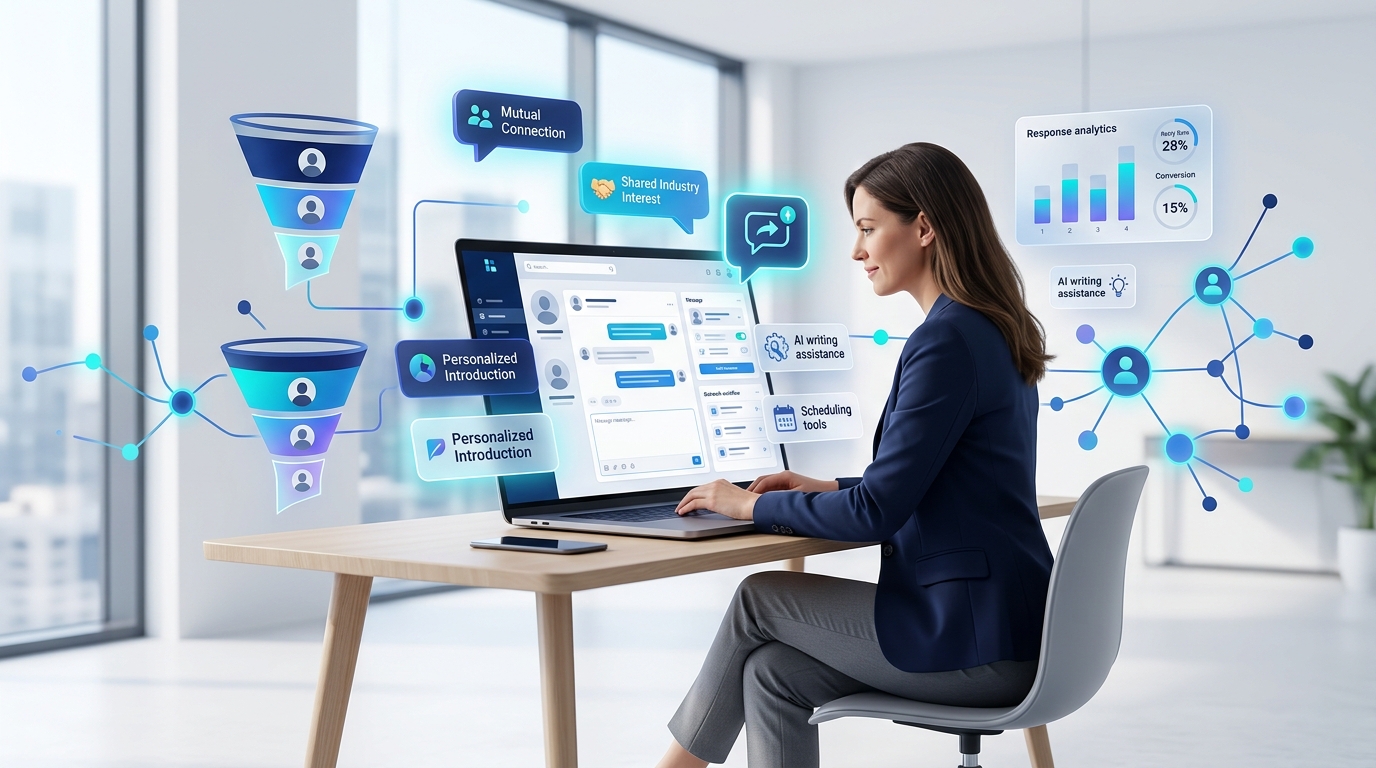
Before getting to templates, it's worth understanding why so many outreach attempts fail in the first place. Three patterns show up constantly:
No context. A connection request with no note, or a note that says nothing beyond "I'd like to add you to my professional network," gives the recipient zero reason to accept.
Ask before value. Messages that lead with a pitch, a sales ask, or a request for someone's time before establishing any actual relevance come across as transactional, and transactional messages get ignored at a far higher rate than messages that lead with something genuinely relevant to the recipient.
Obvious mass personalization. Merge-tag templates that insert a first name and company but otherwise read identically to every other message a person has received this month are easy to spot, and once spotted, they get the same treatment as spam.
The fix isn't complicated, but it does require more thought per message than blasting the same template to a thousand people. It requires genuine personalization, a clear and specific reason for reaching out, and a message short enough that it actually gets read.
Every high-performing linkedin outreach message shares a similar structure, regardless of the specific goal behind it:
A specific, genuine reason for reaching out something referencing their actual work, a post they wrote, or a shared connection, not a generic compliment that could apply to anyone.
A clear, low-pressure ask a short question, a specific request, or an easy next step, rather than an open-ended "let's connect and see where it goes."
Brevity most successful outreach messages run three to five sentences at most. Long messages read as demanding someone's time before they've agreed to give any.
A tone that matches the platform conversational and direct, not overly formal or overly casual for the relationship stage you're actually at.
Every template below follows this same structure, adapted to a different goal.
Template 1: General Networking
"Hi [Name], I came across your [post/project/profile] on [specific topic] and found your take on [specific detail] genuinely useful. I'm working on similar problems in [your field] and would love to connect and follow your work."
Template 2: Sales Outreach (Value-First)
"Hi [Name], I noticed [specific company detail a recent hire, product launch, or public challenge]. We've helped a few companies in [industry] with [specific outcome], and I thought it might be relevant to what you're working on. Open to a quick chat if it's useful no pressure either way."
Template 3: Job Seeker Reaching Out to a Recruiter or Hiring Manager
"Hi [Name], I saw the [specific role] opening at [Company] and wanted to reach out directly. I've spent [X years] in [relevant field], most recently [one specific, relevant accomplishment]. Happy to share more if it's a fit appreciate you taking a look either way."
Template 4: Partnership or Collaboration Request
"Hi [Name], I've been following [Company/Person]'s work in [specific area] and think there could be a genuinely useful overlap with what we're building at [Your Company]. Would you be open to a short call to explore whether it makes sense?"
Template 5: Re-Engaging a Cold Connection
"Hi [Name], it's been a while since we connected I've been following your work on [specific recent update] and wanted to reach out. [Brief context on why now]. Would love to reconnect if you're open to it."
Each of these works because it does the same thing: it proves the sender actually looked at the recipient's profile or work before writing, rather than sending an identical message to everyone in a target list.
Beyond the general templates above, a few specific outreach goals deserve their own approach:
Cold B2B outreach that avoids the sales-pitch trap: Lead with an observation about the prospect's business, not your product. Save the actual pitch for the second message, after they've responded to the first.
Recruiter-to-candidate outreach: Be specific about why this candidate, not a generic "we have an exciting opportunity" opener. Candidates respond far more to messages referencing a specific project or skill from their profile than to generic role descriptions.
Founder-to-founder networking: Reference something concrete about their company's stage or recent milestone. Founders get flooded with generic "let's connect" messages and respond disproportionately well to ones that show real research.
Warm introduction follow-up: Reference the mutual connection explicitly in the first line, and keep the ask small a fifteen-minute call is a much easier yes than an open-ended "pick your brain" request.
A growing category of linkedin ai agents now handles much of the research and first-draft work behind personalized outreach scanning a prospect's recent posts, role, and company details, then drafting a message tailored to that specific context rather than a generic template. Used well, these agents dramatically cut the time it takes to send genuinely personalized messages at volume.
The mistake worth avoiding is treating a linkedin ai agent as a fully autonomous sender. The agencies and sales teams getting the best reply rates in 2026 use these tools to produce a strong first draft, then have a real person review and adjust before anything goes out the same pattern that works for AI-assisted content everywhere else. A message that's 90% AI-drafted but reviewed by a human consistently outperforms one that's sent entirely on autopilot, both in reply rate and in how the relationship develops afterward.
For recruiters specifically, a wide ecosystem of linkedin recruiting tools has emerged to handle sourcing, outreach sequencing, and candidate tracking directly from LinkedIn's interface. These tools typically sit on top of LinkedIn Recruiter or Sales Navigator, adding features like automated sequence tracking, response rate analytics, and candidate scoring based on profile match quality.
A related but distinct category is chrome extensions for linkedin lightweight browser add-ons that layer extra functionality directly into the LinkedIn interface without needing a separate platform login. Popular use cases include exporting profile data, drafting AI-assisted messages inline, and tracking connection request status across a larger outreach campaign. When evaluating chrome extension for linkedin options, prioritize ones that are transparent about data handling and clearly compliant with LinkedIn's terms of service extensions that promise fully automated mass actions (auto-connecting, auto-messaging at high volume) carry real account-restriction risk, since LinkedIn actively detects and penalizes bot-like behavior patterns.
One of the most underused outreach tactics is building light visibility with a prospect before ever sending a connection request. A thoughtful comment on someone's recent post genuinely responding to what they said, not a generic "great post!" makes a subsequent connection request feel far less cold.
This is where a linkedin comment generator or linkedin post comment generator can genuinely help, drafting a contextually relevant comment based on the actual post content rather than a template that could apply to anything. As with outreach messages, the tools that perform best here are the ones treated as a drafting aid rather than an auto-post feature a linkedin comments generator used to draft, edit, then post manually keeps every comment genuinely relevant, while fully automated commenting at scale is exactly the kind of pattern that reads as spam to both the recipient and to LinkedIn's own detection systems.
Beyond tools, a real skills gap exists around outreach itself, and LinkedIn Learning has expanded its library significantly to address it. A LinkedIn Learning AI coach or broader LinkedIn learning AI coaching feature can now walk a user through practicing outreach messages, getting feedback on tone and clarity before sending anything to a real prospect genuinely useful for anyone whose outreach reply rate has plateaued and isn't sure why.
Separately, LinkedIn learning mentoring features connect users directly with more experienced professionals in their field, which while not a direct outreach tool often becomes one of the best sources of genuinely warm introductions, since a mentor's own network tends to respond far more readily to a message that opens with "my mentor, [Name], suggested I reach out."
For anyone specifically hoping to work with LinkedIn coaches on outreach and networking strategy, LinkedIn's own coaching marketplace has grown into a legitimate option alongside independent consultants, giving users a way to get direct, personalized feedback rather than relying purely on generic template libraries like this one.
No outreach template works well if the sender's own profile doesn't hold up to a quick glance from the recipient and this is where LinkedIn profile AI tools have become genuinely useful in 2026. These tools analyze a profile against best practices for headline clarity, summary structure, and keyword relevance for the roles or industries a user is targeting, then suggest specific edits.
Before running any serious outreach campaign, it's worth running your own profile through this kind of review. A recipient who receives a well-crafted, personalized message will almost always click through to the sender's profile before responding and a thin, unclear, or outdated profile can undo all the work that went into writing a good outreach message in the first place.
For anyone trying to stay ahead of this space rather than just react to it, a few linkedin ai trends are worth tracking closely:
Increasingly sophisticated AI agents capable of researching a prospect's full public activity, not just their profile, before drafting outreach.
Tighter platform-level detection of bot-like automated behavior, meaning tools promising fully automated connection requests and messaging carry growing account-risk rather than shrinking it.
AI-assisted comment and engagement tools becoming as normalized as AI-assisted writing tools already are, shifting the competitive question from "who uses AI" to "who uses it without it showing."
Deeper integration between LinkedIn Learning coaching features and real-time outreach tools, closing the gap between learning a skill and practicing it directly inside the platform.
Even with strong templates and good tools, a few habits consistently sink reply rates:
Sending the same message to everyone on a list. Even a strong template needs at least one genuinely personalized detail per recipient to avoid reading as mass-sent.
Following up too aggressively. A single, well-timed follow-up after a week of silence outperforms three rapid-fire messages that read as pushy.
Leading with the ask instead of the context. Every template above works because it establishes relevance before making a request reversing that order consistently hurts response rates.
Ignoring profile quality. A great message paired with a thin, unclear profile still underperforms, since recipients check before responding.
It's worth connecting this back to a broader shift happening across digital platforms this year. Google's June 2026 spam update, its second major spam update of the year, specifically expanded enforcement against scaled, low-effort content built to game a system rather than genuinely serve a real person. That principle is aimed at search content, but it describes exactly what separates outreach that works from outreach that doesn't: genuine relevance and real human judgment beat scaled, generic automation, every time whether an algorithm is evaluating it or a person is simply deciding whether to hit reply.
The tools covered in this guide AI agents, recruiting platforms, chrome extensions, comment generators, profile optimizers all genuinely help when used to remove friction from good outreach. None of them replace the actual work of writing something a specific, real person would want to respond to.
The linkedin connection message template examples in this guide work because they follow the same underlying logic: specific context, a clear low-pressure ask, and genuine brevity. The tools from linkedin ai agents to linkedin comment generators to linkedin profile ai can meaningfully speed up how quickly you produce that kind of message at scale, but they don't replace the judgment behind deciding what's actually worth saying to a specific person.
Start with one template, adapt it to a real person you actually want to reach, and send it today. The templates above are proven starting points, not scripts to copy word-for-word the personalization you add in place of the bracketed details is the actual thing that gets a reply.

Rachel Stanton is a tech writer who specialises in AI productivity tools for busy professionals. He tests and reviews the latest AI software so you can make smarter decisions about where to invest your time and money.
AIReplyBee is your AI-powered LinkedIn reply generator that helps you create authentic, engaging responses in seconds.
Generate your first replyWhat is a collaboration post? Learn how Instagram collab posts work, why they boost reach, and how to set one up step-by-step.
InMail on LinkedIn lets you message anyone, even outside your network. See how it works, pricing, credits, and tips to boost replies.
Learn how to use ChatGPT effectively with the PTCF framework, 7 practical steps, and a real before/after example that actually works.