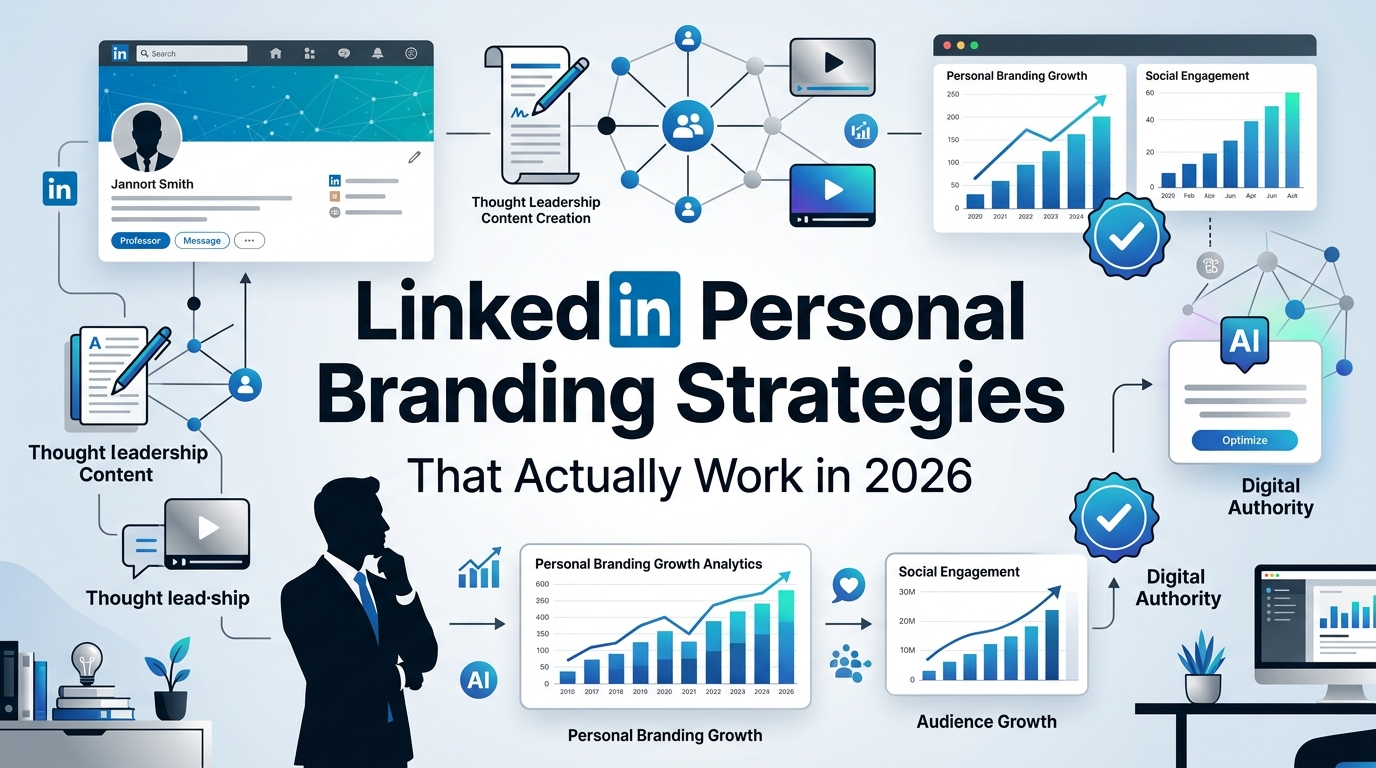
LinkedIn personal branding strategies that actually work in 2026. This guide covers profile optimization, content creation, thought leadership, networking, audience engagement, and personal brand positioning to help professionals, entrepreneurs, and business leaders increase visibility, build credibility, and unlock new career and business opportunities.
Let us cut straight to the truth. Most LinkedIn advice you will find online is recycled, generic, and written by people who have never actually built a meaningful presence on the platform. "Post consistently." "Engage with your network." "Optimize your profile." These statements are technically correct and practically useless without the depth, specificity, and real-world context that makes them actionable.
In 2026, LinkedIn has evolved into something far more sophisticated than a digital resume board. It is the world's most powerful professional publishing platform, the most effective B2B lead generation channel available to individuals, and for the creators who understand how it truly works a business asset that generates opportunities on autopilot while you sleep.
We are going to go deep on the strategies that are actually driving results for LinkedIn's fastest-growing personal brands in 2026. We will cover content strategy, messaging mastery, AI tools that multiply your output without sacrificing authenticity, and the specific techniques that turn a LinkedIn profile from a passive online resume into an active opportunity engine.
Before we get into what works, understanding why most people fail is essential. The LinkedIn landscape has changed dramatically, and strategies that worked three years ago are producing diminishing returns today.
The first problem is surface-level optimization. Millions of professionals updated their headlines, rewrote their About sections, and started posting content — but they did it without a clear strategic foundation. They optimized for the appearance of a personal brand without building the substance that makes a brand worth following.
The second problem is inconsistency born from unsustainable workflows. Creating original, high-quality LinkedIn content manually every day is genuinely exhausting. Most people start strong, burn out after three to four weeks, disappear for a month, and then restart the cycle — never building the consistent momentum that LinkedIn's algorithm rewards.
The third problem is poor messaging habits. LinkedIn is fundamentally a relationship platform, and yet most professionals treat their inbox like a one-way broadcast channel — sending connection requests without personalization, pitching immediately after connecting, and failing to respond thoughtfully to messages they receive. This destroys the relationship potential that makes LinkedIn genuinely valuable.
The professionals who build powerful personal brands in 2026 solve all three of these problems — with a clear strategic foundation, sustainable AI-assisted workflows, and a disciplined approach to LinkedIn messaging and relationship building.
Your LinkedIn profile is your personal brand's 24/7 sales representative. It is working for you — or against you — every moment of every day, whether you are actively on the platform or not. Getting it right is the non-negotiable foundation of everything else.
Your LinkedIn headline appears in search results, connection requests, comment sections, and everywhere your name appears on the platform. It is the single most-viewed piece of text associated with your personal brand, and the vast majority of professionals waste it by writing their job title and company name.
In 2026, the headlines that drive the most profile views and connection requests follow a value-forward formula: the specific problem you solve + the specific people you help + one credibility marker. For example: "Helping B2B SaaS founders turn LinkedIn into their top lead channel | $50M+ in pipeline generated | ex-Salesforce."
Every element of that headline does a job. The first part tells a visitor immediately whether you are relevant to them. The second part builds credibility with a specific, verifiable outcome. The third adds authority through a recognizable association. Together, they create a headline that stops the right people and moves them to click your profile.
The About section is the most underutilized piece of LinkedIn real estate for most professionals. The typical About section reads like a formal biography — third person, past-tense focused, accomplishment-listed. It tells the reader what the person has done without ever speaking to what the reader needs.
In 2026, the About sections that convert profile visitors into genuine connections and opportunities are written in first person, structured like a story with a clear beginning, middle, and end, and focused relentlessly on the reader rather than the writer. They open with a hook that identifies a problem the reader recognizes. They build through a narrative of how the writer came to specialize in solving that problem. They close with a specific call to action that tells the reader exactly what to do next.
Use AI tools to help you draft and refine your About section. A good AI models for text generation prompt for this purpose might be: "Write a LinkedIn About section for a [your role] who helps [your audience] achieve [specific outcome]. Tone: conversational and confident. Length: 250-300 words. Open with a hook about the problem [your audience] faces. Close with a CTA to connect or visit website."
Review the AI output, inject your genuine voice and specific personal details, and you will have an About section that outperforms anything written from scratch in a fraction of the time.
Content is the engine of LinkedIn personal brand growth. Every piece of content you publish is a broadcast to your entire network and, when the algorithm decides your content is valuable, to the networks of your connections as well. Getting your content strategy right is the highest-leverage activity available to you on the platform.
The most effective LinkedIn content strategies in 2026 operate across three tiers, each serving a different purpose in the overall brand-building ecosystem.
Tier One: Insight Posts. These are your highest-value, most shareable pieces of content — original observations, frameworks, or data-backed perspectives on your industry that demonstrate genuine expertise. Tier one posts take the most effort to create but generate the most reach, the most saves, and the most inbound opportunities. Aim for one to two tier one posts per week.
Tier Two: Story Posts. Personal and professional stories that illustrate a lesson, a failure, a surprising discovery, or a career moment that your audience can learn from. Story posts drive high engagement because they are uniquely yours — no AI tool and no competitor can replicate your specific experiences. Aim for two to three story posts per week.
Tier Three: Engagement Posts. Questions, polls, hot takes, and conversation starters designed specifically to generate comments and discussion. These posts drive the most comments and keep your account active in the algorithm between your deeper content. Aim for one to two per week.
Together, these three tiers create a content mix that builds authority, builds connection, and maintains algorithmic momentum simultaneously.
Here is the reality of content creation at scale in 2026: the professionals building the largest and most engaged LinkedIn audiences are almost universally using AI models for text generation to accelerate their content production. The ones who are doing it successfully have learned to use AI as a drafting accelerator rather than a ghostwriter.
The workflow that works best looks like this. You capture a raw idea — a voice note in your car, a bullet point in your notes app, a thought that occurred to you during a client call. You feed that raw idea into your AI tool with a specific prompt that includes your tone, your audience, and the format you want. The AI produces a full draft in seconds. You review that draft, rewrite any sections that do not sound like you, add specific examples and details from your real experience, and publish.
Tools like TextAI, GPT-based writing assistants, and LLM text generators have become standard parts of the LinkedIn creator's toolkit in 2026. The key distinction between creators who use these tools effectively and those who produce generic-sounding content is the quality of their editing. AI produces a first draft — your editing produces a final post worth reading.
For structured content like carousels, frameworks, and numbered lists, AI template generation from text instructions is particularly powerful. You can specify the exact structure you want — "a five-point framework with a title, one-sentence explanation, and one specific example per point" — and the AI will populate that structure with content based on your topic in seconds.
Content gets you visibility. Messaging gets you opportunities. The professionals who build truly powerful LinkedIn personal brands understand that their inbox is where their business actually happens — and they treat it with the strategic care it deserves.
Knowing how to reply to LinkedIn messages effectively is one of the most underrated professional skills in 2026. A thoughtful, well-crafted reply can turn a cold connection into a warm relationship, a warm relationship into a client conversation, and a client conversation into a closed deal.
The framework for an excellent message reply on LinkedIn is simple but consistently overlooked. Acknowledge the specific message rather than giving a generic response. Add something of value — a question, an insight, a resource, or a personal connection to what they shared. And always create a natural next step that moves the conversation forward without being pushy.
When you understand how to reply to a message with genuine intention rather than obligation, your response rate improves, your conversations go deeper, and the quality of your LinkedIn relationships transforms. This is not a technical skill — it is an attentiveness skill, and it differentiates the top 5% of LinkedIn networkers from everyone else.
If your personal brand is working, recruiter messages will come. Knowing how to reply to LinkedIn recruiter outreach strategically — neither dismissing messages that could represent genuine opportunities nor wasting time on roles that are clearly not a fit — is an important skill for any professional with an active LinkedIn presence.
The ideal recruiter reply acknowledges their message, briefly clarifies your current situation and openness to conversations, asks the one most important question you need answered to determine whether the opportunity is worth exploring further, and keeps the door open without making a commitment. This approach respects both your time and theirs and positions you as a thoughtful professional rather than either a dismissive non-responder or an eager candidate who accepts every call.
Using a text reply generator to create templates for common recruiter message scenarios — actively looking, open to the right opportunity, not currently looking — saves significant time and ensures your responses are consistently professional regardless of how busy you are when the message arrives.
As your personal brand grows and your message volume increases, managing your LinkedIn inbox manually becomes increasingly challenging. LinkedIn auto reply features and tools become not just convenient but necessary for maintaining response quality and response time simultaneously.
LinkedIn's native away message feature provides the simplest form of automatic reply LinkedIn functionality. When activated, it sends an automated response to anyone who messages you, letting them know you are unavailable and setting expectations for when they can expect a personal reply. A well-crafted away message includes the reason for your absence, a specific expected response time, and an alternative contact method for urgent matters.
For more sophisticated automatic reply LinkedIn workflows, third-party tools that integrate with your LinkedIn account allow for conditional auto-responses based on message content, sender type, or other criteria. These tools can identify recruiter messages and send a specific template, flag messages from existing connections for priority response, and queue non-urgent messages for batch processing during scheduled inbox time.
The goal of any auto-reply system is not to replace genuine human response but to manage expectations intelligently and ensure that no message falls through the cracks while you are focused on other work.
When you are managing dozens or hundreds of LinkedIn messages per week — which becomes the reality for professionals with established personal brands — a text response generator or text reply generator becomes an essential productivity tool.
The most effective approach is building a library of response templates for your most common message types, then using a text response generator to create personalized variations of those templates based on the specific details of each message. This hybrid approach — template foundation with AI-generated personalization — allows you to maintain the warmth and specificity of a genuinely personal response at a scale that would be impossible to achieve manually.
Tools that offer rizz AI response capabilities go a step further, analyzing the tone and context of incoming messages and generating responses that match the conversational register of the sender — more formal for corporate outreach, more casual for peer-to-peer conversations. This tonal intelligence makes AI-assisted responses feel genuinely personal rather than obviously templated.
The AI tool landscape for LinkedIn creators has expanded dramatically in 2026. Here is a practical guide to the tools that are delivering real results and how to use them effectively.
LinkedIn recommendations are powerful social proof signals that many professionals neglect. A strong recommendation from a credible colleague, client, or manager can be the deciding factor that converts a profile visitor into a connection request or a recruiter into an interview invitation.
An AI review generator helps in two directions. First, it helps you draft recommendation requests that make it easy for your contacts to say yes — a brief, specific prompt that tells them exactly what aspect of your work you are hoping they will highlight makes the task feel manageable rather than overwhelming. Second, it helps you write genuinely thoughtful recommendations for others — an act of generosity that almost always results in reciprocation.
The most effective approach is to use your AI review generator to create a first draft of the recommendation based on your specific experience with the person, then review and personalize it with specific details, anecdotes, and genuine sentiment that no AI tool can supply on its own.
Commenting on other people's LinkedIn content is one of the highest-leverage activities available for growing your personal brand — and one of the most time-consuming when done well. A discussion response generator or AI discussion response generator helps you craft substantive, thoughtful comments faster than you could write them from scratch.
The key is using these tools to add genuine value rather than generate generic responses. Feed the tool the content you are responding to, specify the angle you want your response to take — a contrarian perspective, a supporting example from your own experience, a follow-up question that deepens the conversation — and let it generate a first draft you can refine and personalize.
A discussion post reply generator used this way allows you to engage meaningfully with ten to fifteen posts in the time it would normally take to craft two or three thoughtful responses manually. Over weeks and months, this level of consistent, high-quality engagement builds visibility and relationships across your network at a scale that manual engagement simply cannot match.
The most valuable LinkedIn relationships eventually move beyond the platform itself. When a LinkedIn conversation reaches the point where email is more appropriate — scheduling a call, sending a proposal, following up after a meeting — the transition needs to be smooth and professional.
The Mailmeteor AI email writer and similar tools help you craft follow-up emails that maintain the warmth and momentum of your LinkedIn conversation while meeting the more formal conventions of professional email communication. Whether you need to send a reply to email confirmation, follow up after a discovery call, or send a proposal following a LinkedIn connection, AI email writing tools help you produce professional, personalized communication quickly.
Understanding how to reply for an email professionally in contexts that originate from LinkedIn relationships is a skill that bridges your online personal brand and your offline business development. The best AI email writing tools understand this context and generate correspondence that feels like a natural continuation of the LinkedIn relationship rather than a jarring shift in tone or formality.
Predicting sentence technology — where AI anticipates what you are about to write and offers completions in real time — has become a standard feature of many writing and communication tools in 2026. For LinkedIn power users managing high volumes of messages, posts, and comments, this technology provides meaningful time savings throughout the day.
Tools that integrate predicting sentence capabilities into LinkedIn messaging interfaces allow you to compose thoughtful responses to ai text message and platform messages significantly faster than typing from scratch. The best implementations learn your specific writing style over time, making their predictions increasingly accurate and increasingly useful.
Automated sentence completion tools work particularly well for the formulaic portions of professional communication — greetings, transitions, closings — while leaving the substantive, personalized content for you to supply. This division of labor between AI and human is where these tools add the most value.
For professionals who manage LinkedIn conversations that frequently spill into email, setting up an answer bot or smart auto reply Gmail integration creates a seamless communication system that ensures timely, professional responses across all channels.
Auto reply Gmail tools with AI capabilities can detect the context of incoming emails from LinkedIn connections and suggest or automatically send appropriate responses based on the message content and your pre-configured preferences. For reply to email confirmation scenarios, scheduling confirmations, or standard follow-up situations, these automated responses save significant time while maintaining professional standards.
The most sophisticated setups in 2026 use artificial intelligence response systems that can handle routine email communications entirely — filtering, categorizing, and responding to low-stakes messages automatically while flagging important or complex messages for your personal attention.
With the fundamentals in place, these advanced strategies separate the professionals building merely good LinkedIn brands from those building extraordinary ones.
LinkedIn's newsletter feature remains one of the most underutilized tools on the platform. Unlike regular posts, which appear in the feed and then disappear within 24 to 48 hours, LinkedIn newsletters deliver directly to subscribers' inboxes and notification centers — a significantly higher-quality distribution mechanism.
A weekly or bi-weekly newsletter that consistently delivers genuine value to a specific audience compounds in power over time. Each edition reaches your subscribers directly, is indexed by search engines, builds your authority on your topic, and creates a library of content that continues generating value and subscribers long after each edition is published.
Use best AI for text generation to help you produce newsletter drafts faster, but invest your personal editing time heavily in newsletters — they are longer form, more carefully read, and more closely associated with your authority than any other LinkedIn content format.
DeepAI text-to-image capabilities and research tools have made content ideation significantly more powerful in 2026. Beyond generating text, advanced AI systems can help you identify trending topics in your niche before they peak, surface data and research that supports your content angles, generate original visual concepts for your posts and carousels, and identify content gaps in your space that represent opportunities to establish authority.
DeepWord and similar semantic analysis tools help you understand how your content is perceived by AI systems and search algorithms — increasingly important as more professionals use AI to discover and filter content. Understanding how AI reads and ranks your content gives you an edge in content optimization that most creators are not yet thinking about.
GPT-3 text generator technology and its successors have made content scaling genuinely accessible in 2026. A single strong content idea — a framework, a case study, a research insight — can be scaled into a LinkedIn post, a carousel series, a newsletter edition, a Twitter thread, and a blog post using AI assistance, multiplying your content output without requiring proportionally more creative effort.
The professionals winning at this approach treat themselves as content directors rather than content producers. They supply the original ideas, perspectives, and expertise. They use AI tools to produce the drafts, variations, and format adaptations. And they supply the editing, personalization, and quality control that elevates AI drafts into genuinely valuable published content.
As your personal brand grows, developing a systematic approach to how to respond to a message — whether that is a LinkedIn DM, a comment on your content, or an email from a connection — becomes essential for maintaining the relationship quality that drives continued growth.
Based on text analysis tools can help you categorize and prioritize incoming messages, identify the most important conversations requiring personal attention, and route routine communications to appropriate templates or answer bot responses. This systematic approach ensures that your most valuable relationships receive your best attention while routine communications are handled efficiently.
The goal is not to automate your relationships — it is to automate the administrative overhead of managing a high-volume inbox so that your genuine human attention is concentrated on the conversations that matter most.
Personal branding on LinkedIn in 2026 is not a sprint. The professionals who build the most powerful, most durable brands on the platform share a common characteristic they are playing a long game with discipline and patience that most of their competitors lack.
They understand that long word generator and flashy content tactics produce short-term spikes that do not compound. They know that genuine expertise, consistently shared, builds the kind of credibility that no growth hack can replicate. And they have built sustainable systems combining human creativity with AI efficiency that allow them to show up every week, every month, every year, without burning out.
The personal brand that wins in the long run is the one that is most genuinely useful to the most specific audience over the longest period of time. AI tools help you show up more consistently, communicate more efficiently, and scale your output more sustainably. But the substance — the real expertise, the genuine personality, the authentic perspective — that has to come from you.
LinkedIn personal branding is the process of building a professional identity on LinkedIn by showcasing your expertise, experience, achievements, and unique value to attract career opportunities, clients, or business connections.
Personal branding helps professionals stand out in a competitive market, increase visibility, establish authority, grow their network, and attract job offers, partnerships, and business opportunities.
You can improve your LinkedIn personal brand by optimizing your profile, sharing valuable content regularly, engaging with industry discussions, highlighting achievements, and maintaining a consistent professional message.
Thought leadership posts, industry insights, case studies, personal experiences, professional achievements, educational content, and actionable tips tend to perform well on LinkedIn.
For consistent growth, professionals should aim to post at least 3 to 5 times per week while actively engaging with comments and industry conversations.
Yes. A strong LinkedIn personal brand can attract recruiters, increase professional credibility, create networking opportunities, and open doors to career advancement.
Your LinkedIn headline is one of the first things people see. A clear, keyword-rich headline helps communicate your expertise and improves profile discoverability in LinkedIn searches.
Absolutely. Entrepreneurs use LinkedIn personal branding to build trust, establish authority, generate leads, attract clients, and position themselves as industry experts.
Common mistakes include incomplete profiles, inconsistent posting, overly promotional content, lack of engagement, unclear messaging, and ignoring audience needs.
Building a strong LinkedIn personal brand typically takes several months of consistent content creation, networking, profile optimization, and audience engagement, but long-term results are often highly rewarding.

Rachel Stanton is a tech writer who specialises in AI productivity tools for busy professionals. He tests and reviews the latest AI software so you can make smarter decisions about where to invest your time and money.
AIReplyBee is your AI-powered LinkedIn reply generator that helps you create authentic, engaging responses in seconds.
Generate your first replyWhat is a collaboration post? Learn how Instagram collab posts work, why they boost reach, and how to set one up step-by-step.
InMail on LinkedIn lets you message anyone, even outside your network. See how it works, pricing, credits, and tips to boost replies.
Learn how to use ChatGPT effectively with the PTCF framework, 7 practical steps, and a real before/after example that actually works.